

2005 , Vol. 01 >Issue 02: 96 - 98
DOI: https://doi.org/10.3877/cma.j.issn.1673-5250.2005.02.108
新生儿急性呼吸衰竭呼吸机撤离时的呼吸力学研究
Copy editor: 孙激
网络出版日期: 2023-07-25
基金资助
本课题为深圳市科委2003年立项资助项目(200304236)
The measurement of respiratory mechanics and its clinical significance in newborns weaning from mechanical ventilation
Online published: 2023-07-25
探讨新生儿机械通气撤机时呼吸力学指标的范围及临床意义。
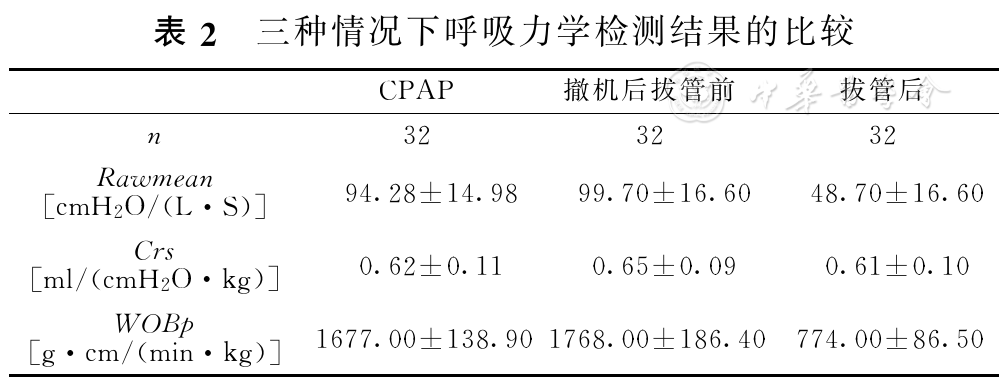
测定32例机械通气撤机时,新生儿在持续气道正压(CPAP )模式、脱机拔管前及拔管后20min等条件下的呼吸力学指标范围。根据拔管48h内是否重新插管,将以上病例分为撤机成功组与失败组。
成功组的呼吸力学范围:平均气道阻力(Rawmean)为(93. 7 ± 14. 3)cmH2O/(L·S) (lcmH2O = 98. 07Pa)、呼吸系统顺应性(Crs)为(0. 65±0. 09)ml/(cmH2O · kg)、呼吸功(WOBp)为(1589± 133. 2)g · cm/(min · kg);失败组:Rawmean为(98. 6±15. 5)cmH2O/(L · S)、Crs为(0. 57±0. 08) ml/(cm H2O·kg)、WOBp为(1782±148. 6)g ·cm/(min · kg)。Crs与两组差异有显著意义(P<0. 05),脱机成功率为95.4%。
呼吸力学的检测对新生儿呼吸机的撤离有指导作用,特别是对呼吸系统顺应性和呼吸功的检测,更具有实际意义。
王少华 , 杨军 , 李志勇 , 匡凤梧 . 新生儿急性呼吸衰竭呼吸机撤离时的呼吸力学研究[J]. 中华妇幼临床医学杂志(电子版), 2005 , 01(02) : 96 -98 . DOI: 10.3877/cma.j.issn.1673-5250.2005.02.108
To explore the range of respiratory mechanics values on weaning ventilators in mechanical ventilated newborns and its clinical significance.
Thirty-two ventilated newborns were measured for indices of respiratory mechanics using a Bicore CP-100 pulmonary monitor under a continuous positive airways pressure of 3cmH2O, and in the periods of pre-extubation after ventilator weaning and 20 min post-extubation. Extubation success was defined as no reintubation within 48 hours of extubation.
In the extubation success group, Rawmean (mean airway resistance) was (93. 7 ±14. 3)cmH2O/(L • S), Crs (respiratory system compliance) (0. 65 ± 0. 09) ml/(cmH2O • kg), WOBp(work of breathing, patient ) (1589 + 133. 2) g • cm/(min • kg); in the extubation failure group, Rawmean(98. 6+15. 5)cmH2O/(L • S), Crs(0. 57 ± 0. 08)ml/(cmH2O • kg), WOBp(1782 ± 148. 6) g • cm/(min •kg). There were significant differences between the two groups in Crs and WOBp. The rate of successful weaning was 95. 4%.
Bedside measurements of improved respiratory mechanics (WOBp, Crs)can be used to predict the outcome of mechanical ventilation withdrawal in neonates. Pulmonary function testing may help choose the optimal time for extubation in infants.
Key words: lung mechanics; respiratory failure; weaning; infant; newborn

|
1 韩玉昆.呼吸机在儿科的临床应用.中国实用儿科杂志,1994,5:18-27.
|
|
2 Macdonale KD, David D,Wirttscharter M, et al. Continuous neonatal pulmonary mechanics with the Bircore CP-100 monitor. Neonatal intensive care,1992(11/12):55-61.
|
|
3 周晓光,肖欣,农绍汉主编.新生儿机械通气治疗学,第1版.北京:人民卫生出版社,2004,223-261.
|
|
4 Julian JA,Ephrain BY,Brya C,et al. Respiratory mechanics in infants :Physiologic evaluation in health and disease. Am Rev Respir dis, 1993,147:477-496.
|
|
5 王少华,匡凤梧,吴仕孝等.新生儿呼吸窘迫综合症呼吸力学的动态监测及离别意义.中国实用儿科杂志,2001,16(2):92-94.
|
|
6 Migdal M,Dreizzen E,Prand TP,et al. Compliance of the total respiratory system in healthy preterm and full-term newborns. Pediatr Pulmonol, 1987,3:214-222.
|
|
7 Balsam MJ, Jones JG, Watchko JF, et al. Measurement of pulmonary mechanics prior to the elective extubation of neonates. Pediatr Pulmonol, 1990,9:238-243.
|
|
8 Oca MJ, Becker MA, Dechert RE, et al. Relationship of neonatalendotracheal tube size and airway resistance. Respir Care,2002Sep,47(9):994-997.
|
|
9 Mehta S, Nelson DL, Klinger JR, et al. Prediction of post-extubation work of breathing. Crit Care Med, 2000 May, 28(5):1341-1346.
|
/
| 〈 |
|
〉 |